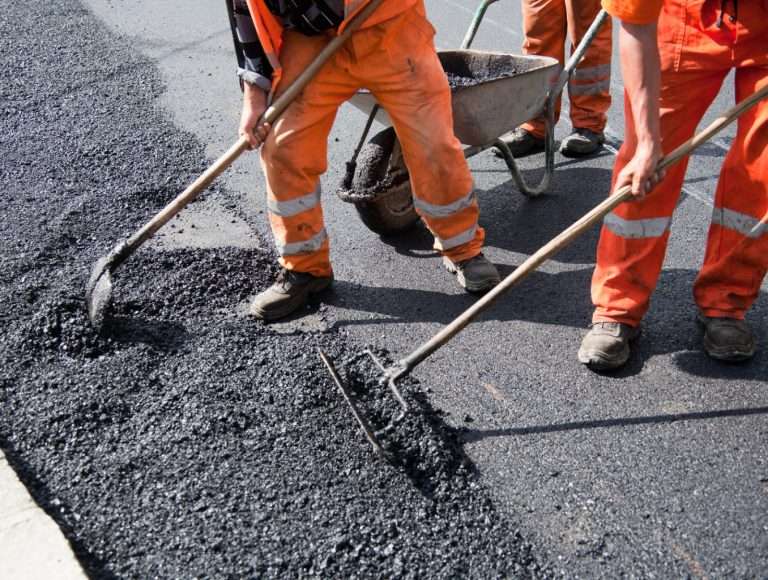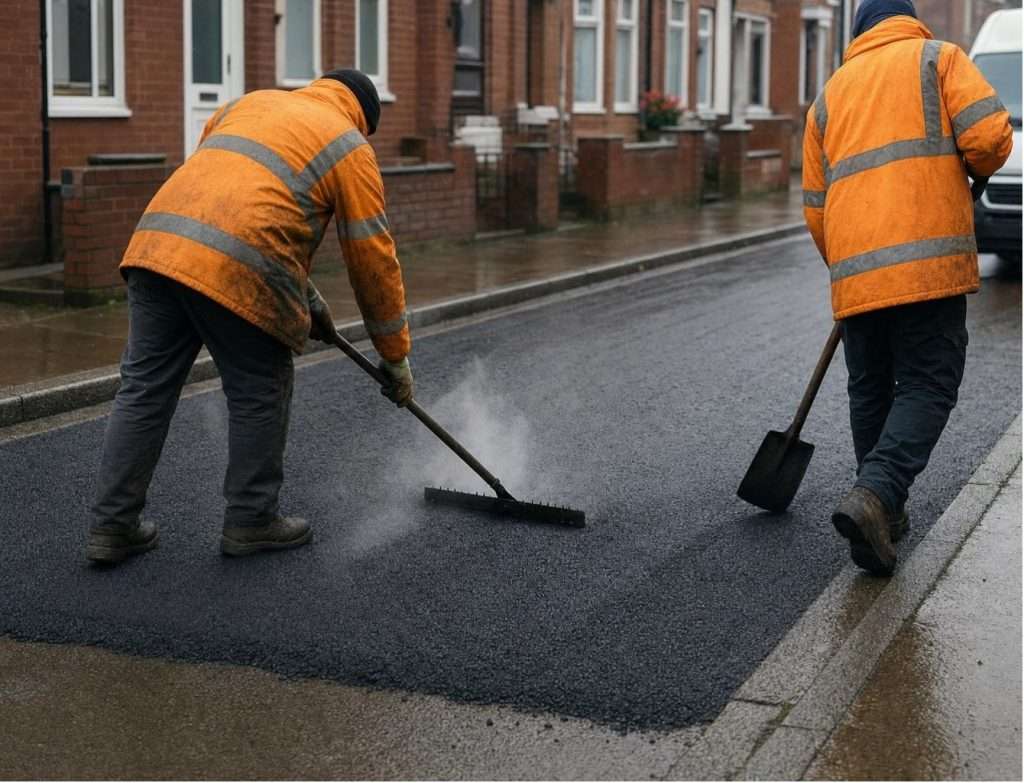
You can usually lay tarmac in the rain. What stops a surfacing job is water sitting on the surface that’s about to be covered, or rain heavy enough to chill the asphalt before the crew can roll it. If you’ve been told to wait for a dry day, that’s the cautious answer, not a general rule.
Tarmac here means what it means on any UK site today: asphalt, bound with bitumen (the history is in tarmac vs asphalt). This guide is for anyone with resurfacing, patching or a trench reinstatement booked and a wet forecast: what decides whether the job goes ahead, who makes the call, and what to ask beforehand. It’s written from McFadden’s tarmac and road surfacing work across Hertfordshire, London and the South East.
Why rain matters to hot asphalt
Hot asphalt has to be compacted while it’s still hot. Each material has to reach site above a minimum temperature and be rolled before it cools below another, or the crew can’t close it up to the density it needs. For trench reinstatements in the public highway, the Specification for the Reinstatement of Openings in Highways (SROH) sets those temperatures for each material.
Minimum temperatures for three common asphalts with 40/60 binder (SROH Table A2.7)
| Material | In the lorry on arrival, at least | Rolled before it cools below |
|---|---|---|
| Hot rolled asphalt surface course | 140°C | 110°C |
| Asphalt concrete binder course | 130°C | 100°C |
| Stone mastic asphalt | 130°C | 100°C |
Rain matters because it takes heat out of the mat. A light shower makes little difference to a thick layer. Steady rain, wind, or water lying on the surface underneath pulls the temperature down faster, and the crew is left rolling material that’s already too cool to compact properly. Water sitting on the surface also gets between the new layer and the one below it, and weakens the bond between them.
Once asphalt has been rolled and has cooled, rain does it no harm.
What actually stops a surfacing job
On McFadden’s surfacing jobs, the work generally carries on as normal in the rain. What stops it is water sitting in the area that’s about to be surfaced, such as puddles on a planed surface or water lying in a trench.
Published specifications put the line at standing water and heavy rain, not at rain as such. The Welsh Government’s stone mastic asphalt specification, for example, says the material must not be laid on a surface covered in frost, ice, snow or standing water, and must not be laid during heavy rain.
Heavy rain is a stop because it cools hot asphalt too quickly to roll and soon leaves water standing on the surface. Light rain or drizzle on a surface with no water sitting on it is usually workable.
If it rained the night before, the test in the morning is whether water is sitting on the surface. Puddles and standing water have to be gone before the asphalt goes down. A surface that’s only damp is a different thing from one with water lying on it.
Who makes the call, and whose rules apply
Under the published specifications, the contractor makes the call on the day. The Welsh Government’s stone mastic asphalt specification puts it plainly: the contractor decides whether conditions are suitable to start or carry on working, and responsibility for the work stays with the contractor. That puts the decision with the people on site, looking at the surface and the sky, not with a forecast alone.
The weather rules behind the contractor’s decision sit in BS 594987, the British Standard for transporting, laying and compacting asphalt. A council’s or client’s own specification can then add its own limits. North Yorkshire Council’s road pavement specification, for example, stops laying when rain gets heavier than 1 mm an hour, and doesn’t allow laying during rain that’s forecast to last more than two hours. The same specification lets the bond coat go onto a damp surface, as long as it’s free of standing water.
On any surfacing job, the specification in the contract matters as much as the forecast.
Why thin layers and patches are most at risk
A thin layer loses its heat fastest. A 30 mm surface course or a small patch holds far less heat than a 60 mm binder course, so it has the shortest window to be rolled, and rain or wind closes that window quickly. Thicker layers are much more forgiving.
Published specifications set tighter limits for thin layers. The Welsh Government’s stone mastic asphalt specification won’t let a layer thinner than 30 mm be started until the air temperature reaches 5°C, while a layer of 30 to 50 mm can start at 0°C on a rising temperature. It also notes that strong wind chills a fresh surface much faster than a low air temperature does.
If you’ve been told asphalt has to be laid between 10°C and 30°C, that range isn’t a specification limit. The limits that do exist depend on the layer’s thickness, the wind and the material, and they start at around 0°C for thicker layers. Cold weather, and what rain and temperature do once the asphalt is down, is covered in how long tarmac takes to dry.
Cold applied materials, and trenches in the public highway
On a utility trench in the public highway, or any other reinstatement after street works, the SROH applies, and it treats cold applied materials in two ways. Certified cold applied materials (the SROH calls them permanent cold-lay surfacing materials) with a current Product Acceptance Scheme certificate can be used for permanent reinstatement: at any position in footways, footpaths and cycle tracks, and as the binder course and surface course on Type 3 and 4 roads. A cold applied material without that certificate can’t be used as a permanent reinstatement.
The idea that cold applied is only ever a temporary fix is true of many bagged repair products, but not of certified materials laid under the SROH. A certified material also has to be stored, handled and laid exactly as its certificate says, so the conditions it can go down in are set by the certificate, not by a general rule. McFadden’s cold applied work covers ironwork surrounds, pothole response and utility reinstatement.
On a highway trench, the SROH lets the undertaker choose an interim reinstatement where that’s appropriate for the circumstances, and an interim reinstatement must normally be made permanent within six months. The way permanent and interim reinstatements work is covered in how the SROH works.
What to ask before a wet surfacing day
If rain is forecast for a surfacing day, these are the questions worth asking the contractor beforehand. None of them is “will it rain?”.
- What's being laid
- Which layer and how thick, or a patch. Thin layers are the most weather-sensitive.
- Whose specification
- The contract's, and whether it sets its own rain limit.
- What gets checked on the morning of the job
- Whether water is sitting on the surface, not just what the forecast says.
- Who makes the call
- The contractor, on site, on the day.
- On a highway trench
- Permanent or interim reinstatement, and whether any cold applied material is certified.
Rain rarely decides a surfacing job on its own; water sitting on the surface does. McFadden's tarmac and road surfacing covers hand-lay and machine-lay patch repairs, resurfacing and new surfacing. Every job starts with a site visit, larger schemes get a method statement and a programme before work starts, and the surface is laid to NRSWA specification where it meets adopted highway, and to the local council's own standards wherever they're stricter.
Questions on this topic
Yes, usually. Light rain on its own rarely stops a surfacing job. What stops it is water sitting on the surface to be covered, or rain heavy enough to cool the asphalt before it can be rolled. The contract’s specification can set its own limit, so it’s worth checking before the day.
No. Heavy rain cools hot asphalt too quickly to compact properly and soon leaves water standing on the surface. Published specifications, such as the Welsh Government’s stone mastic asphalt specification, say the material must not be laid during heavy rain.
Usually, yes. The test in the morning is whether water is still sitting on the surface. Puddles and standing water have to be gone before the asphalt goes down, but a surface that’s only damp is a different matter: North Yorkshire Council’s specification, for example, lets the bond coat go onto a damp surface as long as it’s free of standing water.
It depends on the product. A certified cold applied material has to be laid exactly as its certificate says, including the conditions it can go down in, and some cold applied products shouldn’t go onto a very wet surface at all. Bagged repair products from a builders’ merchant are generally temporary repairs.
The contractor, on the day, working within the contract’s specification. The team on site looks at whether water is sitting on the surface, how heavy the rain is, the wind and the thickness of the layer, rather than relying on the forecast alone.
The weather rules for laying asphalt in the UK sit in BS 594987, and a client’s or council’s own specification can add its own limits, such as a maximum rainfall rate. The “light precipitation” allowance of less than 0.5 mm an hour that you may have seen quoted comes from older versions of the Specification for Highway Works and its notes for guidance. It was dropped in 2008, and later versions point to BS 594987 instead.
Yes. In winter, cold and wind usually matter more than rain, especially for thin layers, which lose their heat fastest. Published limits depend on the layer: thicker layers can be started at around 0°C, while thin surface courses need a higher air temperature. Asphalt shouldn’t be laid on a frozen surface.