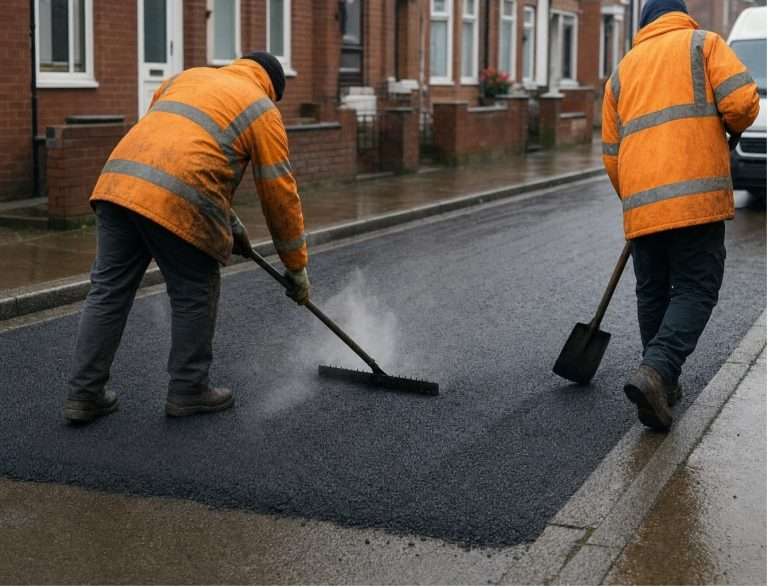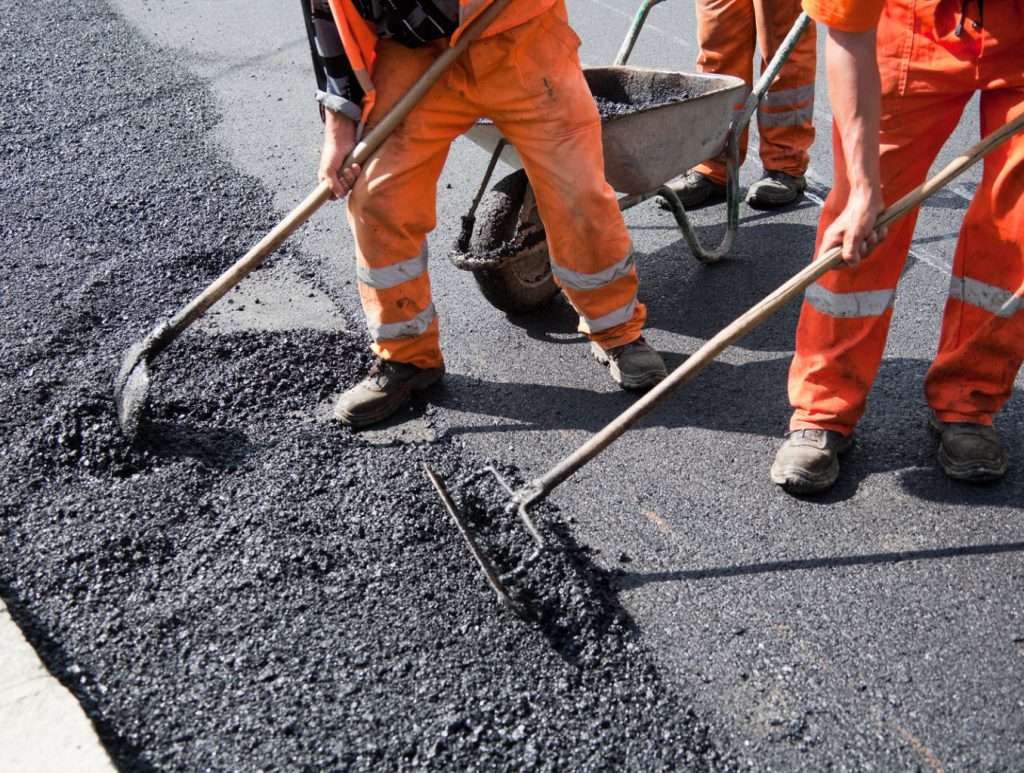
In the UK, tarmac and asphalt now mean the same thing in practice: crushed stone bound with bitumen, which the industry calls asphalt and most people still call tarmac. Tarmac originally meant stone bound with tar, from a process patented in 1902, and road tar was used in UK roads until the mid-1980s.
This guide covers where the two names come from, the asphalt types a tarmac and road surfacing contractor will actually quote for, why the layers under the surface matter more than the name, and what to ask for in a quote.
Where the name tarmac comes from
Macadam was John McAdam’s method of surfacing roads with crushed stone. It suited horse-drawn traffic, but the stones were not bound together, and once cars became common the roads rutted and turned to mud in the rain.
In 1902, Edgar Purnell Hooley, a county surveyor in Nottinghamshire, patented a process of heating tar, adding slag and breaking stones into the mix to form a smooth road surface. In 1903 he formed Tar Macadam Syndicate Ltd and registered Tarmac as a trade mark, and in 1905 the Wolverhampton MP Sir Alfred Hickman relaunched the business, as the BBC’s account of Hooley’s invention sets out.
Tarmac, the company, still trades today and calls its own surfacing range asphalt. The Cambridge Dictionary still lists Tarmac as a brand name, while also using the word for any area covered in it or a similar material.
Is tarmac the same as asphalt?
In practice, yes. Tar and bitumen are both sticky black binders, but they come from different sources: road tar is processed from coal tar, and bitumen is produced from crude oil. It was also common to blend the two.
According to guidance on managing reclaimed asphalt from the Association of Directors of Environment, Economy, Planning and Transport (ADEPT), road tar could have been used in any layer of a road up until the mid-1980s, with only isolated use after that. Bitumen is the binder used today.
What gets laid today on a road, car park or driveway and called tarmac is asphalt. National Highways, which runs England’s motorways and major A roads, puts it simply: “Most of our strategic road network is surfaced with asphalt, also known as blacktop or tarmac.”
You may have heard that the old tar version is the one that breaks down when diesel is spilt on it. Tar was actually valued for resisting diesel: ADEPT notes it may still have been used after the mid-1980s in a few places, such as bus depots and lay-bys, for that reason.
The asphalt types you’ll actually be quoted for
Asphalt is a family of mixes rather than one material. In the UK, each mix is made to a part of the BS EN 13108 series, with the British Standards Institution’s PD 6691 as the guidance on using them here. The Specification for Highway Works, in the Series 900 version used until its 2025 update, gave the old names alongside the new ones, describing dense base and binder course asphalt concrete as “formerly macadam”.
Tarmac, macadam and asphalt: what the names mean today
| What you might hear | What it is today | UK standard |
|---|---|---|
| Tarmac, tarmacadam | The everyday name for an asphalt surface. Originally stone bound with tar | None: Tarmac is also a brand name |
| Macadam, bitmac, dense bitumen macadam (DBM) | Asphalt concrete (AC): graded stone coated with bitumen | BS EN 13108-1 |
| Hot rolled asphalt (HRA) | An asphalt whose surface course can have coated chippings rolled into it | BS EN 13108-4 |
| Stone mastic asphalt (SMA) | An asphalt used for surface and binder courses | BS EN 13108-5 |
| Porous asphalt | An open mix that lets surface water drain through | BS EN 13108-7 |
| Blacktop | Another name for asphalt | None |
A quote for “macadam” or “bitmac” and a quote for “asphalt concrete” can be for the same material, and a quote for “tarmac” could be for any of the asphalts in the table.
Surface, binder and base: why the layers matter more than the name
An asphalt road is built in layers. From the top down there is a surface course, a binder course and a base, laid over a sub-base, and each layer can be a different mix. Series 900 of the Specification for Highway Works, for example, had separate clauses for asphalt concrete base and binder courses, for hot rolled asphalt surface and binder courses, and for SMA binder and regulating courses, all laid and compacted to BS 594987.
Two quotes that both say “tarmac” can therefore describe very different jobs: a new surface course over the old road, or a full rebuild of the binder course, base and sub-base underneath. McFadden’s tarmac crews level the sub-base where needed and lay to specification thickness.
When a trench is dug in the public highway, the layers have to be put back to a set standard. These reinstatement works follow the SROH, the statutory reinstatement specification for highways in England.
What to ask for instead of “tarmac”
A quote that only says “tarmac” doesn’t say what is being laid, or how deep. These are the details worth having in writing before work starts.
- Surface course
- Which asphalt: asphalt concrete, hot rolled asphalt or SMA
- Binder course and base
- Whether they are being replaced, and the mix and thickness of each
- Sub-base
- What is there now, and whether it needs work
- Drainage
- Where the water will go, or porous asphalt if it needs to soak through
- Standards
- Mixes to BS EN 13108, laid to BS 594987, and the SROH for trench reinstatements in the public highway
- Hot or cold applied
- Which one, and when the surface can take traffic
Hot applied asphalt and cold applied surfacing harden in different ways, which affects when a surface can be used. Our guide to how long tarmac takes to dry covers both. Whether it can go down in the rain at all is a separate question, covered in can you lay tarmac in the rain.
On price, there is no tarmac versus asphalt difference to compare, because the two words describe the same material. What changes the price is the specification: which layers are being laid, how thick, over what area, and what the ground underneath needs.
McFadden Utilities runs tarmac and road surfacing crews from its Hertfordshire depot, hand-laying and machine-laying patch repairs, resurfacing and new surfacing across London and the South East, to NRSWA specification wherever the work meets adopted highway.
Tarmac and asphalt questions
Asphalt, which most people call tarmac. National Highways says most of England’s strategic road network is surfaced with asphalt, also known as blacktop or tarmac. Around 400 miles of that network, about 4%, is concrete.
No. Bitumen is the binder that holds the stone together in asphalt, and it is produced from crude oil. What people call tarmac today is the finished mix: graded stone coated with bitumen. The original tarmac used road tar, processed from coal tar, instead of bitumen.
The word is, for asphalt. Road tar itself could have been used in UK roads up until the mid-1980s, with only isolated use after that, and bitumen is the binder today. The surface people call tarmac now is asphalt.
Yes. Edgar Purnell Hooley registered Tarmac as a trade mark in 1903, and Tarmac is still a company today. The Cambridge Dictionary lists it as a brand name, even though the word is also used for any similar surface.
Usually asphalt or blacktop. Tarmac is also used for the areas of an airport where aircraft park, land and take off.
Dense asphalt, the usual type, is relatively impermeable. Porous asphalt, made to BS EN 13108-7, is the exception: it is an open mix that lets surface water drain through.
SMA, stone mastic asphalt, is one specific type of asphalt, made to BS EN 13108-5 and used for surface and binder courses. Tarmac is the everyday word for asphalt in general, so an SMA surface is one kind of what most people would call tarmac.