Lead water pipes are the old lead supply pipes that still connect many homes built before 1970 to the water main. Lead was commonly used for that connection until it was banned, and older homes that have not been modernised often still have some, underground, indoors or both.
This guide covers how to tell if you have lead pipes, whether they are dangerous, what the law says, who pays for which part, and what replacing a lead supply pipe involves in the Thames Water, Affinity Water and SES Water areas.
How to tell if you have lead water pipes
A home built before 1970 may have lead pipes. A home built after 1970, or an older one whose pipework has all been replaced since, is unlikely to.
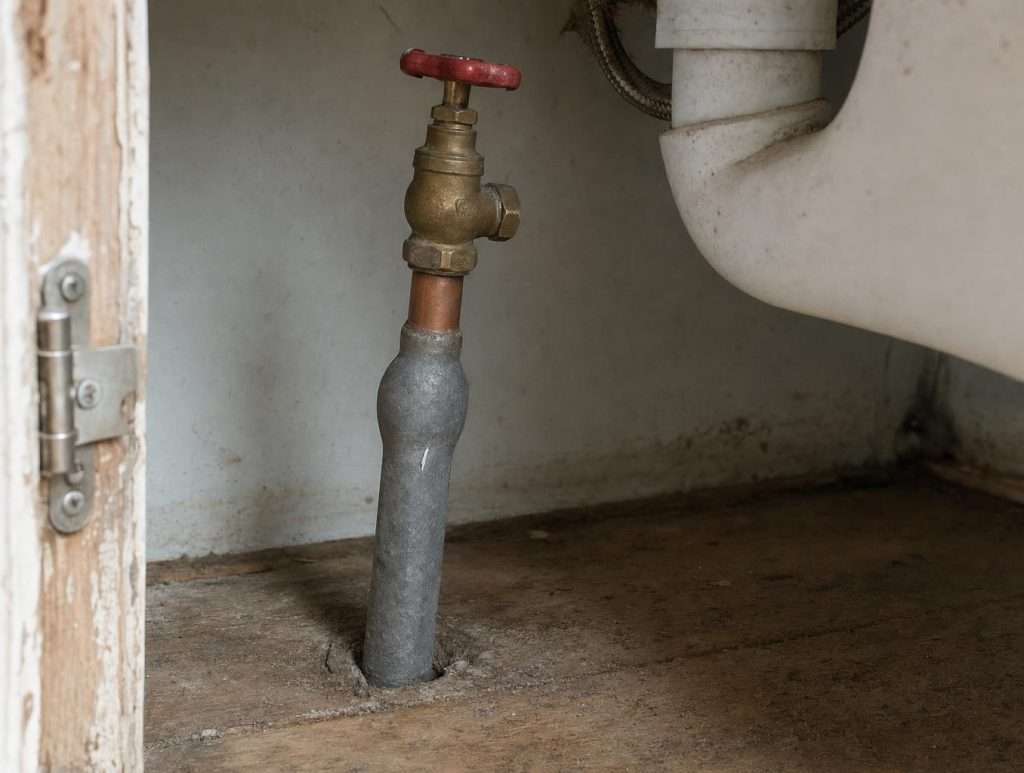
Start at the inside stop tap, usually under the kitchen sink or the stairs. Unpainted lead pipe is dull grey and soft, often with a rounded, swollen joint next to the tap, and a gentle scrape with a coin shows shiny, silver-coloured metal underneath. Wash your hands afterwards.
Telling lead from other water pipes
| Pipe material | What it looks like | Other checks |
|---|---|---|
| Lead | Dull grey and soft, often with a swollen joint by the tap | Shiny silver under a coin scratch; a dull thud when tapped with metal |
| Copper | Bright or dull brown, and hard | A clear ring when tapped |
| Galvanised iron | Dark, very hard, sometimes rusty | A clear ring when tapped |
| Plastic | Blue, or grey or black if older | Blue MDPE is the usual replacement pipe |
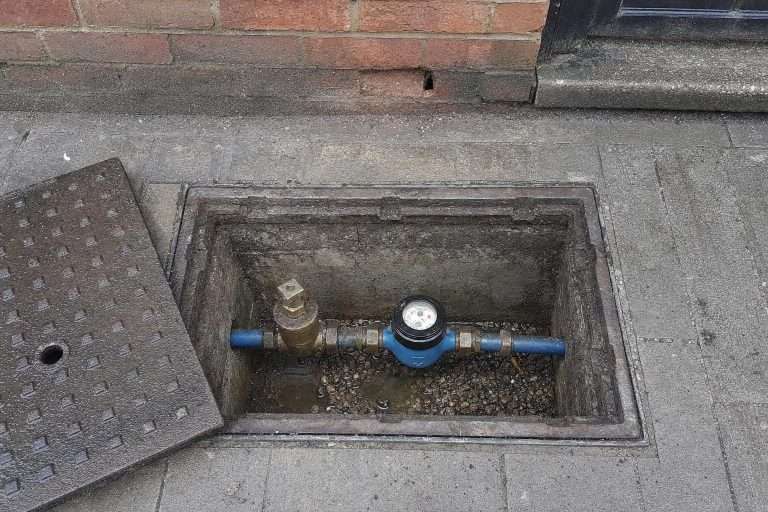
Copper at the stop tap does not settle it: most houses have been re-plumbed above ground, but lead can still run in the ground under the property. Look at the pipe in the outside stop valve chamber too. If you are still unsure, ask your water company to test the water at your kitchen tap, or ask a WaterSafe-approved plumber.
Are lead water pipes dangerous?
Lead can dissolve into water while it stands in a lead pipe, so a home with lead pipework will usually have some lead in its drinking water. The Drinking Water Inspectorate (DWI) says the people most at risk are infants, including unborn babies, and children, because lead can harm mental development.
How much gets in depends on how long the water stands, the state of the pipe, the temperature and the hardness of the water. Where there is a risk, water companies add phosphate to the water to bring lead levels down, but lead particles can still build up in old pipes.
The legal limit is 10 micrograms of lead per litre (10 µg/l) at the customer’s tap. If you have lead pipes, use only the cold kitchen tap for drinking and cooking, and run it first when the water has been standing, such as first thing in the morning, until it runs noticeably colder. A washing-up bowl full is usually enough, though a long supply pipe takes longer. Boiling the water does not remove lead. For health questions, start with the UK Health Security Agency’s lead information for the public.
Are lead pipes illegal? What the law says
The bans cover new work. Lead pipe can no longer be installed for drinking water, and using lead solder on drinking water pipes has been illegal since 1999, although lead solder is still allowed on closed central heating systems.
For lead already in the ground, the replacement duty in the drinking water regulations sits with the water company. Under regulation 30 of the Water Supply (Water Quality) Regulations 2016, which apply in England, a water company must modify or replace its part of a lead pipe when two conditions are both met.
- The duty
- The water company must modify or replace its part of the pipe
- First condition
- The owner has given written notice that they will replace their part and want the water company to replace the rest
- Second condition
- The water company has reason to believe the water at the tap contains, or is likely to contain, more than 10 µg/l of lead
- Which pipes
- A pipe mainly made of lead, under mains pressure, owned partly by the water company and partly by the owner
For the owner's own pipe, the DWI's advice is that lead pipes should be replaced as soon as possible, and Affinity Water advises customers to line or replace any lead pipework. In practice, Thames, Affinity and SES each replace their part when the owner replaces theirs, on terms each company publishes.
Who owns which part, and who pays
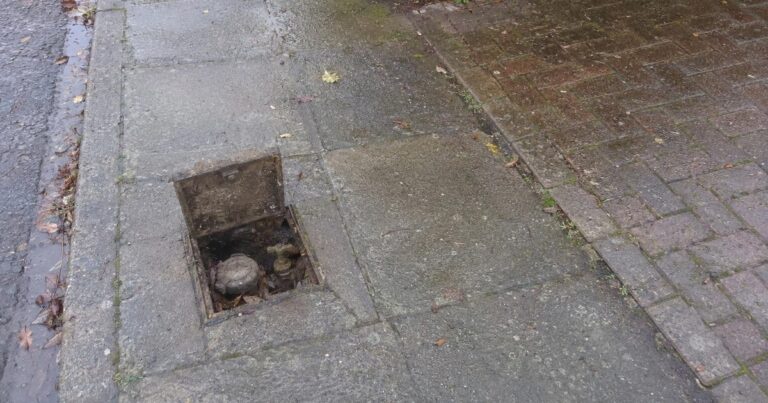
A lead supply is two pipes with two owners. The communication pipe, from the water main to the outside stop valve, usually at the boundary, belongs to the water company; Thames Water, for one, says it is responsible for fixing or replacing it. The supply pipe from the outside stop valve into the house, and the plumbing inside, belong to the owner.
Where the outside stop valve sits in the pavement rather than the front garden, part of the owner's pipe runs under the public highway too, and a contractor needs a street works licence to dig there.
Who pays for what when you replace a lead supply
| Part of the job | Who does it | Who pays |
|---|---|---|
| Lead pipe or lead solder inside the house | Your plumber | You |
| Supply pipe from the outside stop valve to the house | Your plumber or contractor | You |
| Digging and making good on your own land | Your plumber or contractor | You |
| A shared length of supply pipe | Everyone on it | Shared between the owners |
| Communication pipe from the main to the outside stop valve, and the road or pavement over it | The water company | The water company, on its scheme's terms |
Thames's scheme is a like-for-like replacement, although old 12 to 15 mm lead pipe is replaced with the standard 25 mm. A larger pipe than that goes through Thames's new connection process, and our guide to new water connection costs sets out the published charges.
Lead pipe replacement schemes: Thames, Affinity and SES
Thames Water, Affinity Water and SES Water all replace their own lead pipe once the owner has replaced theirs. What each one asks of the owner first is slightly different.
What each scheme asks of the owner
| Scheme detail | Thames Water | Affinity Water | SES Water |
|---|---|---|---|
| Your part | Lead supply pipe replaced up to the outside stop valve | All lead from the boundary stop tap to the inside stop tap | All lead within the property boundary |
| Sign-off | Thames inspects the open trench, or an approved plumber's certificate | Trench left open for inspection at both ends | SES inspection, or a WIAPS approved plumber's certificate |
| Shared supplies | Not separated under the scheme | Neighbours' lead has to be replaced too | Eligible |
On Thames's scheme, you apply first and replace your part within three months. Thames then traces its own pipe, arranges the permits and traffic management, and aims to replace it within three months of you qualifying, with the road or pavement usually made good within two working days. Getting your own supply instead of a shared one is a new connection, covered in our guide to shared water supplies.
Where an Affinity boundary stop tap is in the public highway, an approved contractor with a section 50 licence can connect the new pipe to it directly. An approved contractor without one joins the new pipe to the old lead with a lead lock fitting as a temporary measure, leaving enough pipe to reach the boundary stop tap plus an extra metre, and Affinity makes the connection.
SES pays for its part itself, or subsidises the work where the route involves abnormal costs. Thames and Affinity also have lead strategies agreed with the DWI, and both replace their own lead pipes where samples show lead at or above 5 µg/l, half the legal limit. Affinity replaces the customer's supply pipe too in those cases, and Thames is targeting 54,000 lead communication pipe replacements by March 2030.
You may have heard that Thames pays a cash grant towards the private pipe. Thames's scheme pages describe replacing Thames's own pipe, not a cash grant towards yours. Outside these three areas, check your own water company's terms, as some offer grants.
What replacing a lead supply pipe involves on the ground
Replacing a lead supply pipe means laying a new pipe, usually blue MDPE, from the outside stop valve to the inside stop tap, along the old route or a better one. The new pipe goes in by open trench or by moling, where a pneumatic tool bores a tunnel between two small pits and the pipe is pulled through behind it. Moling saves digging up a front garden or driveway along the whole route, but it is not always possible. Whether a mole can be used usually comes down to the ground conditions and the other services already buried along the route.
Other services means the gas pipes, electricity cables, telecoms ducts and water mains in the ground, which have to be located before any bore. Our guide to how moling works covers that survey and the soil types that suit a mole.
Whichever method is used, the new pipe has to meet the water company's requirements. Affinity, for example, wants it to come into the house under the foundations, ducted and in most cases insulated, and Thames requires an approved inside stop valve. The owner makes the first contact with the water company. From there, McFadden Utilities finds the old lead pipe, lays the new one, connects it at both ends and makes good, and sorts the permits and traffic management where the work is in the road.
Before and after the work: run the taps
Disturbing a lead pipe can raise the lead in your water for a while. Until both the owner's part and the water company's part have been replaced, the water still runs through the lead that is left.
On Thames Water's scheme, run the cold kitchen tap for about two minutes before using it until Thames has replaced its pipe. On the first day after the replacement is complete, run every tap used for drinking or cooking for 10 minutes.
Across Thames, Affinity and SES, the owner's part comes first, done to the water company's rules and signed off, and the water company replaces its part after. Thames also wants an application before the work starts, so check your own company's process before anyone digs. McFadden replaces lead supply pipes as part of its new water connections work across Hertfordshire, London, Surrey, Essex, Cambridgeshire and Berkshire.
Questions about lead water pipes
Installing new lead pipe for drinking water is banned, and using lead solder on drinking water pipes has been illegal since 1999. For lead already in the ground in England, the replacement duty in the Water Supply (Water Quality) Regulations 2016 sits with the water company, which must modify or replace its part when the owner gives written notice and the lead at the tap is likely to be over 10 µg/l. For the owner’s own pipe, the Drinking Water Inspectorate advises replacing lead pipes as soon as possible.
No. Boiling water does not remove lead. If you have lead pipes, use only the cold kitchen tap for drinking and cooking, and run it before use when the water has been standing in the pipe, for example overnight.
In the Thames Water, Affinity Water and SES Water areas, the published schemes replace the water company’s own lead pipe when you replace yours. Thames’s scheme pages describe that replacement, not a cash grant towards your pipe, and SES replaces its part at its own expense unless the route involves abnormal costs, when it subsidises the work instead. Some other water companies offer grants, so if you live elsewhere, check your own company’s scheme.
Yes. If you suspect lead pipes, ask your water company to test the water at your kitchen tap. If it finds lead pipes or another source of lead, it should give you written advice on what to do. Thames Water, for example, will collect samples if you are not in a position to replace your pipe, and replaces its own pipe if the samples show high lead levels.
Yes. If you are buying, the Drinking Water Inspectorate suggests asking your surveyor to check the outside and inside pipes, with special mention of lead. It also notes that buyers increasingly make the cost of removing lead pipes part of their price negotiations.
Usually blue MDPE (medium-density polyethylene) plastic pipe. On Thames Water’s scheme, Thames replaces its own lead pipe with a new 25 mm plastic pipe. The owner’s new pipe has to meet the water company’s requirements; Affinity Water, for example, wants it to come into the house under the foundations, ducted and in most cases insulated.
Fittings made to join onto lead pipe do exist: Affinity Water has contractors use a lead lock fitting to connect a new pipe to the existing lead supply as a temporary measure. Any repair leaves the lead in place, though, and the Drinking Water Inspectorate warns that working on a lead pipe can raise lead levels for a while, so flush the tap well for at least 10 minutes afterwards. The DWI’s advice is to replace lead pipes as soon as possible.