
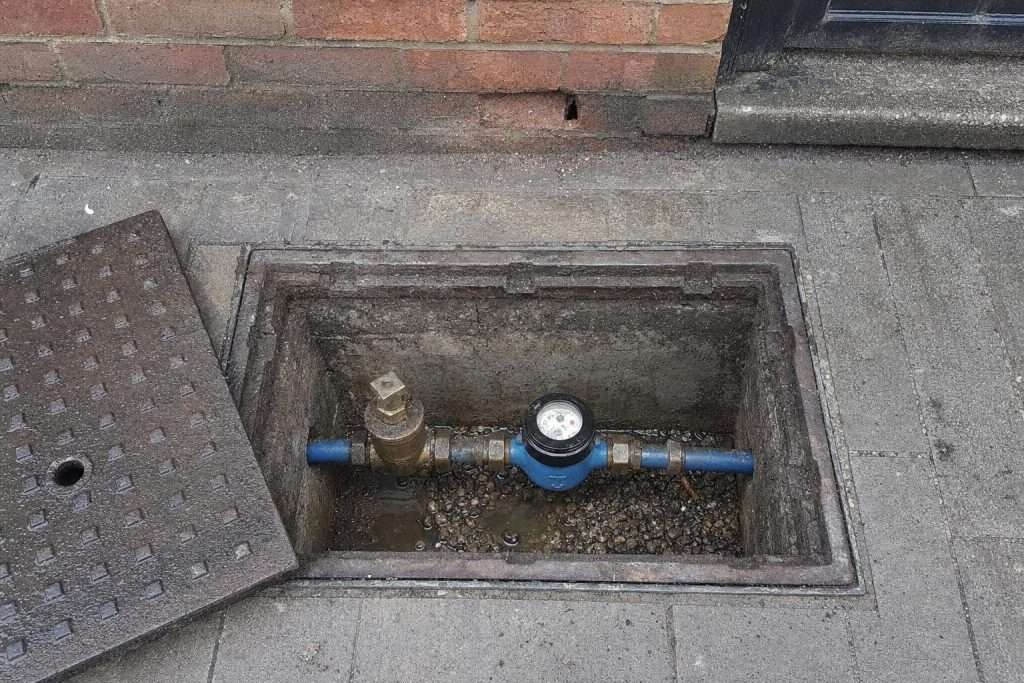
A business water meter in England belongs to the regional water company, known in the business water market as the wholesaler, so you can’t replace or move it yourself. You ask your water retailer, the company that sends your bill, and the wholesaler or one of its approved contractors does the work.
This guide covers who owns the meter, how a request works, what Affinity Water and Thames Water charge for 2026/27, and where a water meter installation contractor fits in.
Who owns a business water meter?
Since April 2017, businesses, charities and public sector organisations in England have been able to choose who supplies their retail water services. In Wales, only customers using more than 50 million litres a year can choose. Ofwat describes the wholesalers as the companies “that own and operate the network of pipes, mains and treatment works”.
The meter is part of the wholesaler’s equipment. Affinity Water’s metering policy puts it plainly: “The stop tap and the meter are apparatus belonging to us.” Your retailer runs your account and passes meter requests to the wholesaler. If you’re not sure who your retailer is, it’s the company named on your bill, or Open Water’s retailer finder, built by MOSL, the market operator, can help you find it.
How a replacement request works
Your retailer raises the request with the wholesaler under Part B of the Wholesale-Retail Code’s Operational Terms, the business water market’s rules for metering work. Each type of job has its own process, and the Thames Water metering code of practice lists the four that matter here.
- B1
- A new meter on a supply that doesn't have one
- B3
- A meter accuracy test
- B5
- Repair or replacement of a faulty meter
- B7
- A change of meter size, model or location
Most metering work starts with a survey. Affinity Water charges for it, from £146 for one hour, except for a genuine fault or when it can fit a new meter on the first visit. Thames Water fits the meter on the same visit where it can, or comes back for a second visit, and updates the market's central system once the work is done.
New meters are increasingly digital. Thames is phasing them in on new installations and replacements, and Affinity Water plans to upgrade every business meter to a smart meter between April 2026 and 2035, writing at least 22 business days before it fits one. Under its own replacement programme, Thames makes no charge for a like-for-like exchange in normal working hours, though it may charge for extra work.
What it costs: faults are free, changes are charged
A meter that has stopped, been damaged or gone missing is the wholesaler's to fix. A change you ask for, such as a bigger meter or a new position, is charged. Both companies publish their 2026/27 charges in their wholesale tariffs: Affinity Water's wholesale charges and Thames Water's wholesale tariff.
Business meter charges for 2026/27, ex VAT, in working hours
| Request | Affinity Water | Thames Water |
|---|---|---|
| Faulty, damaged or missing meter | No charge, unless the customer damaged it (then charged as a requested change) | No charge, unless the customer caused the fault (then £155 to £2,001) |
| Accuracy test | £613 to £1,839 plus survey if the meter is accurate; no charge if it's faulty | £356 to £2,630 plus a £63 survey if the meter is accurate; no charge if it isn't |
| New size or model of meter | £252 to £1,269 plus survey in the existing box or pit; £859 to £2,015 if the box or pit needs altering | £155 to £2,001, plus a £63 survey where needed |
| Moving the meter | £859 to £2,015 plus survey | £63 survey, then priced on application |
| Survey | From £146 for one hour | £63 |
These are wholesale charges, billed to your retailer, so ask your retailer to confirm in writing what you'll pay before any chargeable work goes ahead. Thames's ranges cover meters up to large; the largest sizes are priced on application.
A fault stops being free mainly in three situations: the meter was damaged by the business or someone on site, the meter turns out to be working, or you ask for the work out of hours. Affinity charges a damaged meter as if you had asked for a change, and charges the survey if the meter is found to be working. Thames charges an abortive visit, £53 to £134 in working hours, if the meter turns out to be working.
Think the meter is wrong? Check before you ask for a test
An accuracy test is free only if the meter turns out to be wrong. If it's accurate, the test is charged: from £613 plus a £146 survey at Affinity Water, and from £356 plus a £63 survey at Thames Water. Both remove the meter, fit a replacement and send the old one away for testing, which at Thames means a UKAS-certified test house.
Thames treats a meter as working correctly if it reads within 6% at lower flow rates and 2.5% at upper flow rates, bands Thames says are defined by ISO 4064:2014, and it won't test a meter that was tested in the previous three months. It also doesn't count a meter as faulty if it can be read and is safe to read.
A jump in readings can also mean a leak on your side of the meter, so check for one before paying for a test. Our guide to who is responsible for a water leak covers business supplies as well as homes.
Moving or upsizing a meter
A business can ask for its meter to be moved, but the wholesaler has to approve it. Thames Water treats an approved relocation as a chargeable service and follows a set order of preferred locations: an existing boundary box first, then the public highway, then private land, then a shared internal area in flats or commercial units, and only then inside the premises.
At Affinity Water, moving the meter doesn't move the line between your pipe and the water company's. Affinity says that where it relocates a meter, it remains "responsible for the pipework up to the original stoptap".
At Thames, a change of size has to be backed by evidence of peak flow, and it accepts three ways of working it out: the fixtures and fittings on site, total consumption, or data logging. It also warns that "Any potential downsize could lead to issues with pressure and flow."
How much water reaches the premises is limited by the supply pipe. Thames puts it simply: "The bigger the supply pipe from a water main to your property, the more water will flow from your tap." If a new kitchen or process needs more flow than the existing supply can carry, the answer is a bigger supply pipe, which Thames covers in its guidance on new water connections. Our guide to new water connection costs sets out the 2026/27 charges.
Where your own contractor fits
Work on the wholesaler's meter is the wholesaler's job. Affinity Water says it is "responsible for carrying out any metering works", and Thames Water says "Only contractors or developers that we have approved are permitted to install our meters."
There is one opening at Affinity. Its policy says it may agree to adopt a meter you've had installed, if the meter meets the measuring instruments rules and isn't a lower class than Affinity's own, is fitted to the water fittings and meters regulations, can be read, and records all the water used at a single premises. Thames says it won't adopt a meter that is outside its approved list or that it hasn't supplied, so check through your retailer before anyone fits one.
The business's side of the supply may also need work before a new meter can go in. Where it does, Affinity tells the customer what's needed, closes the request and asks for a new one once "the customer alterations have been completed".
The supply pipe stays the property's to maintain wherever the meter sits; Affinity says the meter's location "does not alter your liability to maintain and repair your supply pipe". A supply shared with neighbours raises its own questions, covered in our guide to shared water supplies.
McFadden Utilities is a water meter installation contractor based in Hertfordshire, delivering meter installations, replacements and flow meter work across London and the South East. It installs and exchanges meters as a Tier 2 subcontractor on water company metering programmes, builds the purpose-built chambers that larger commercial meters sit in, and carries out new water connections as a WIRS-accredited contractor.
Business water meter questions
No. The meter belongs to the wholesaler, and tampering with it so it can’t record accurately, or doing work you know will affect it or that needs it disconnected, is an offence under section 175 of the Water Industry Act 1991 without the appropriate consent. Ask your retailer to raise a request, and the wholesaler or one of its approved contractors will do the work.
The wholesaler, in most cases. Affinity Water bears the cost unless the customer damaged the meter, and Thames Water makes no charge in working hours. It’s charged if the meter was damaged on site, if it turns out to be working, or if you ask for the work out of hours.
Yes, if the wholesaler approves it. Ask your retailer to raise the request. Affinity Water’s 2026/27 charges for moving a meter run from £859 to £2,015 plus a survey, ex VAT in working hours, depending on meter size, and Thames Water prices moves on application. At Affinity Water, moving the meter doesn’t change who is responsible for which pipe.
It’s the company named on your water bill. If you don’t have a bill to hand, Open Water’s retailer finder, built by MOSL, the market operator for the business water market, can help you find it.
Generally not. The meter belongs to the wholesaler, and Thames Water’s policy is to meter all non-household properties wherever feasible and practical. If you think a meter is faulty or in the wrong place, ask your retailer about a repair or a move instead.
Wholesalers replace meters that are faulty or ageing, and run replacement programmes. Affinity Water plans to upgrade every business meter to a smart meter between April 2026 and 2035, and Thames Water is phasing in digital meters on replacements. Thames makes no charge for a like-for-like exchange under its programme in normal working hours.
It depends on your peak flow rate, and the wholesaler decides. Thames Water asks for evidence from the fixtures and fittings on site, total consumption or data logging before it changes a meter’s size, and warns that a smaller meter can lead to issues with pressure and flow.


