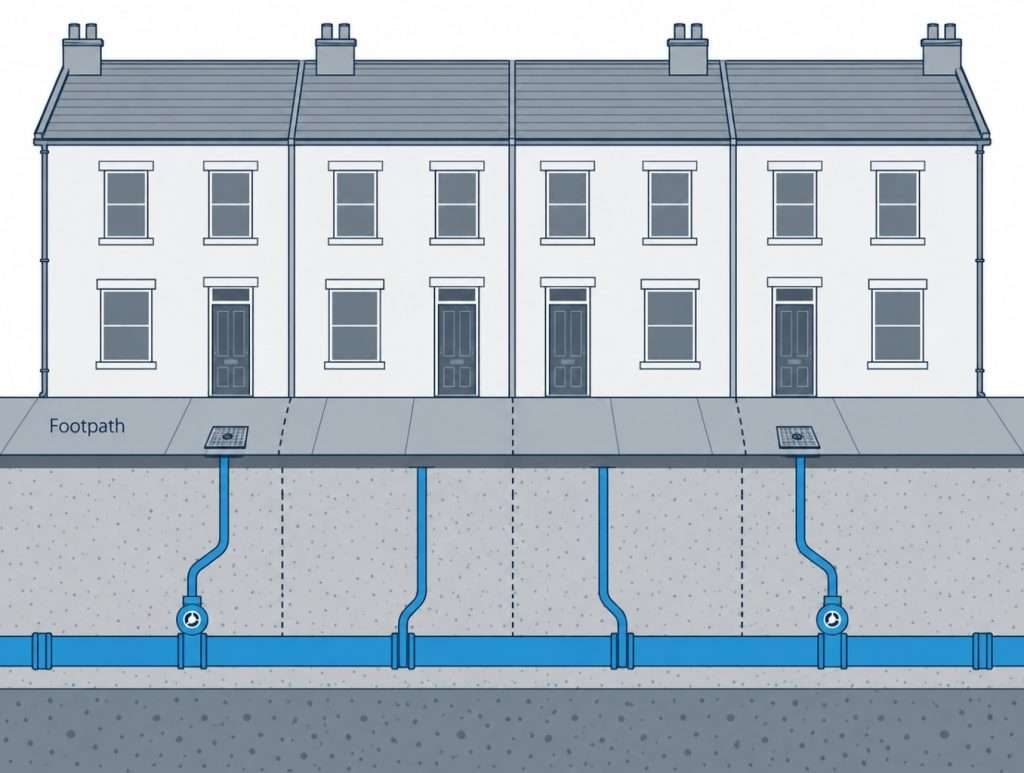
A shared water supply is where one supply pipe from the water company’s connection feeds two or more homes before branching off to each one. It is common on older terraced and semi-detached streets, and the owners of every home on it are jointly responsible for the shared length of pipe.
Most people find out they share a supply when something goes wrong: a leak nobody wants to pay for, pressure that drops when next door runs a bath, or a refused water meter. This guide covers who is responsible, when the water company can step in, and what separating a shared supply onto its own pipe involves, with the current Thames Water and Affinity Water charges.
Are you on a shared water supply?
A shared supply usually gives itself away. Pressure drops when a neighbour is using water, there are fewer outside stop taps in the pavement than houses in the row, or the title deeds mention shared pipework or rights over a neighbour’s land.
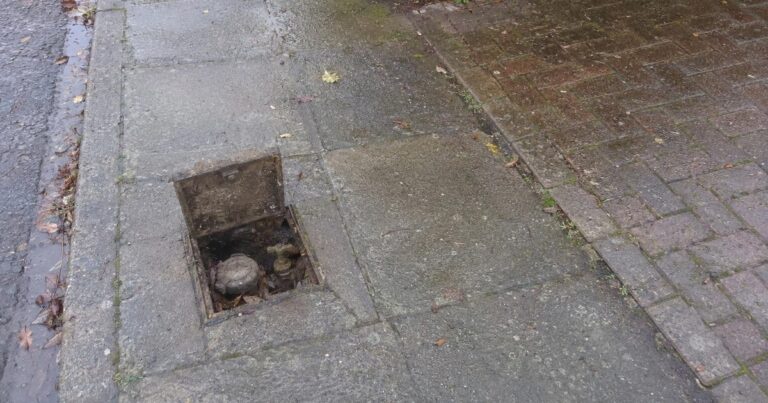
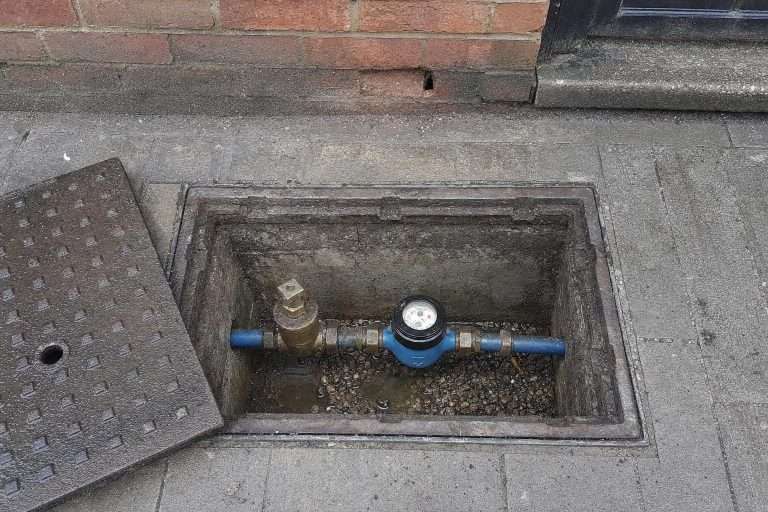
The simplest check is the stop tap test. Warn the neighbours first, turn off your outside stop tap, which is usually in the meter chamber at the boundary, and run your kitchen tap until it stops. If their taps stop too, the supply is shared. If the result is unclear, a WaterSafe-approved plumber can trace the pipe.
When the shared pipe leaks
Everyone on a shared supply is jointly responsible for the shared length of pipe and the cost of repairing it. Thames Water is clear on this, and equally clear that it does not get involved in disputes between neighbours over it. A leak on the branch serving only your home is yours alone.
You may hear that the bill is split equally by default, or by how much water each home uses. No water company or regulator sets a split. It is for the owners to agree, and agreeing it in writing before anything fails is far easier than agreeing it in the middle of a leak.
Thames expects a confirmed leak on private pipework to be repaired within four weeks. Working out where a buried leak sits, and whose pipe it is on, is covered in our guide to who is responsible for a water leak outside your house.
Getting your own supply: who does which part
Separating a shared supply means giving your home its own connection to the main and its own supply pipe, then disconnecting it from the shared one. The work splits into two halves, and who does each half is where most of the confusion lies.
Who does what when you separate a shared supply
| Part of the job | Who does it |
|---|---|
| Applying for a new connection | You, as the property owner, to your water company |
| New supply pipe from the house to the boundary | Your own contractor or plumber |
| Connection to the main, pipe to the boundary, boundary box and meter | The water company, or an accredited self-lay provider where the quote allows |
| Disconnecting your home from the shared pipe | Depends on whether your neighbours separate too |
On Thames Water’s process, you apply for a quote, your plumber lays the new pipe from the house to the boundary, and Thames connects it to the main. A WaterSafe-approved plumber can self-certify the private pipe; otherwise Thames inspects it. Thames aims to connect within four months of agreeing permits with the highway authority.
The road half does not have to be the water company’s own crew. Thames’s charging arrangements treat household service connections up to 63mm as contestable work that an accredited self-lay provider can carry out, unless the main is a trunk main or made of a higher-risk material such as asbestos cement or PVC. Affinity Water’s quote for a separation shows its own price and the self-lay price side by side.
McFadden Utilities is a WIRS-accredited water contractor that does both halves. The owner makes the first call to the water company, and McFadden takes it from there: the new pipe from the house, the connection to the main where the water company allows a self-lay provider to make it, and reinstating the path or road afterwards.
What the water company charges
A separation is applied for as a new connection. Thames and Affinity both price it by the surface where the main is opened, and both charge far less when someone else does the digging.
Single 25 to 32mm connection, 2026/27, excluding VAT
| Where the main is opened | Thames Water | Affinity Water |
|---|---|---|
| Road | £6,470 | £2,334 |
| Footpath | £4,570 | £2,097 |
| Unmade ground or verge | £2,520 | £1,957 |
| Excavation by others | £1,110 | £632 |
| Extra pipe, per metre in a road | £780 | £174 |
Fees sit on top: Thames charges £105 to apply and £190 for the design, and Affinity charges £185 to apply plus a £125 administration fee. All of these figures come from the 2026/27 charging arrangements of Thames Water and Affinity Water, exclude VAT and change every April. Contaminated ground needs barrier pipe, which costs more.
A straight separation should not normally carry an infrastructure charge. On both companies’ 2026/27 wording, that charge applies to premises being connected for the first time, and a house already on a shared pipe has been connected. Converting a house into flats is different, because the new homes are new connections. Check the quote either way.
These are the water company’s charges only. Laying the new supply pipe across your own land is a separate cost that depends on distance and surface, and our guide to new water connection costs shows how the two halves of the bill fit together.
Your neighbours and the old pipe
Neighbours who stay on the shared pipe keep their rights to it, even where it runs under your land, and that shapes how the disconnection happens. Affinity Water only cuts a joint supply off at the main once everyone on it is separating. Otherwise, disconnecting your home is a private arrangement, and where the point of disconnection is on a neighbour’s land, you need their permission first. Disconnection at the main is free for households at both Thames and Affinity.
Water meters on a shared water supply
A shared supply is one of the reasons a water company can refuse a meter, because there may be nowhere to fit one that measures a single home’s use. The Consumer Council for Water lists a joint supply that needs separating as a reason for refusal, and says you may be able to pay an assessed charge instead. Thames only moves a household onto its assessed charge if that lowers the bill.
Separating fixes this at the root. A new service connection normally comes with its own boundary box, outside stop valve and meter, so your home’s water use can be measured on its own.
When the water company can make you separate
Most separations are voluntary, but section 64 of the Water Industry Act 1991, which applies in England and Wales, lets a water company require a property to have its own service pipe. Where two or more houses already share one, it cannot insist until one of five things happens.
- Defective pipe
- The privately owned part of the shared pipe needs renewing, or can no longer meet the needs of the houses on it
- Unpaid bill
- A water charge for any of the houses is left unpaid after it falls due
- Conversion
- Structural alterations turn the houses into a larger number of homes
- Interference
- An owner or occupier interferes with the shared pipe and affects another home's supply
- Likely interference
- The water company has reasonable grounds to believe that interference is likely
If one of those applies, the water company can serve notice, and you then have three months to lay your part of the new pipe. If you do not, the company can do the work itself, recover what it reasonably spent, and cut off the old supply once the new one is running. Either side can refer a dispute over the five conditions to Ofwat.
You may have been told that low water pressure on its own lets the company force a separation. It does not, although a shared pipe that can no longer meet the needs of the houses on it does count.
For most households, separating is a choice rather than an order, usually prompted by a leak, poor pressure or a refused meter. The order of work is the same either way: apply to the water company, lay the private pipe, make the connection, and deal properly with the old one. McFadden carries out new water connections, including shared supply separations, across Hertfordshire, London and the South East.
Questions on shared water supplies
Warn your neighbours, turn off your outside stop tap, which is usually in the meter chamber at the boundary, and check whether their taps stop as well as yours. If they do, the supply is shared. Pressure that drops when a neighbour runs water, fewer outside stop taps than houses in the row, and mentions of shared pipework in your title deeds are other signs.
On a shared supply, one stop valve can control the water to more than one home, so it can happen. The Water Supply (Water Fittings) Regulations 1999 require a stop valve that shuts off each home without affecting the others, and a stop valve every occupier can reach on a shared pipe. Those rules do not apply to pipework lawfully installed before 1 July 1999, so many older shared supplies do not meet them.
You can apply for your own supply without your neighbours separating too. You will need a neighbour’s permission if your new pipe has to cross their land, or if the point where your branch must be cut off sits on their land. Neighbours who stay on the old pipe keep their rights to it, even where it runs under your property.
Often, yes. Converting a house into more homes is one of the five conditions in section 64 of the Water Industry Act 1991 that let a water company require separate supplies, and water companies usually expect each self-contained flat to have its own supply and meter. The new homes created by a conversion can also attract the infrastructure charge, which a straight separation of an existing house normally does not.
Sometimes, but a shared supply is one of the reasons a water company can refuse to fit a meter, because there may be nowhere to measure a single home’s use. If a meter cannot be fitted, you may be able to pay an assessed charge instead. Separating onto your own supply normally brings a new boundary box and meter with it.
Check the title deeds, and ask the seller whether the supply is shared, where the shared pipe runs and whether any rights or repair arrangements with the neighbours are recorded. Ask what the pipe is made of too, as older supplies can still be lead, and our guide to lead water pipes covers how to check. Your conveyancer can raise these questions, and the answers tell you whether separating is worth budgeting for.
Most of the time goes on the application and quote rather than the dig. Affinity Water confirms it has what it needs within five calendar days and sends cost advice within 28 days. Thames Water quotes are valid for 180 days, and Thames aims to connect within four months of agreeing permits. The work on site for a single property is usually a day or two.
Often, if the shared pipe is the cause. When several homes draw on one supply pipe, pressure drops at busy times, and water companies list low pressure and flow among the reasons people separate. An old or narrow shared pipe makes it worse, so a new pipe of the right size can help. If the problem is in the water main itself, separating will not fix it.