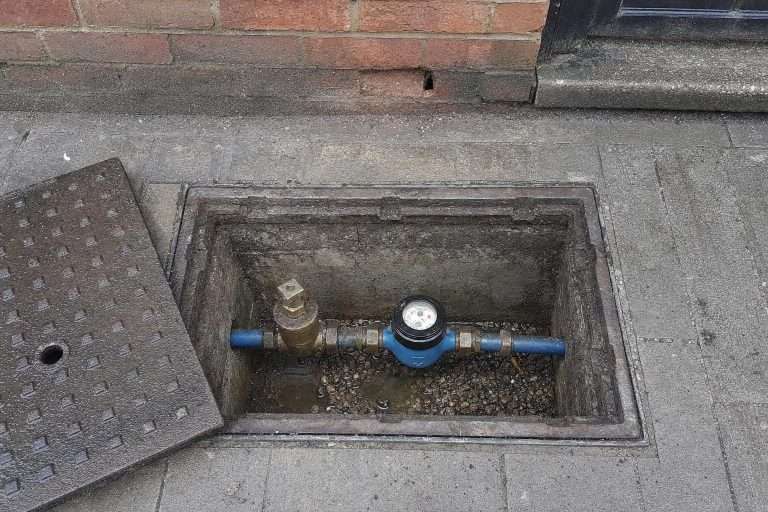
When you have low water pressure in the house and every tap is affected, there’s a quick way to find out whose problem it is: compare two points, the flow at the kitchen cold tap and the flow at the boundary box outside. That one comparison shows whether the fault sits with the water company or with your own supply pipe, and it saves a lot of guesswork.
The comparison also draws a useful line. If only one tap or the shower is weak, the cause is usually the plumbing inside the house, and that is a plumber’s job. If the whole house is affected, the problem is usually in the supply: the supply pipe that brings water into your home from the main in the street. This guide covers that supply side, from the main to the first tap.
Is it just your house?
A sudden drop that your neighbours have too usually means something has happened on the network, such as a burst main or repair work nearby. Thames Water customers can check the live incident list and postcode map from its no water or low pressure page, and Affinity Water customers can check its live service alerts. Pressure also dips at busy times, in the morning, early evening and dry spells, so a weaker flow at 7am is not always a fault.
Check that the inside stop tap, usually under the kitchen sink, is fully open. It is easy to leave half closed after other work. A slow decline over months or years, with the neighbours unaffected, often points at the supply pipe.
Whose pipe is it? The main, the communication pipe and your supply pipe
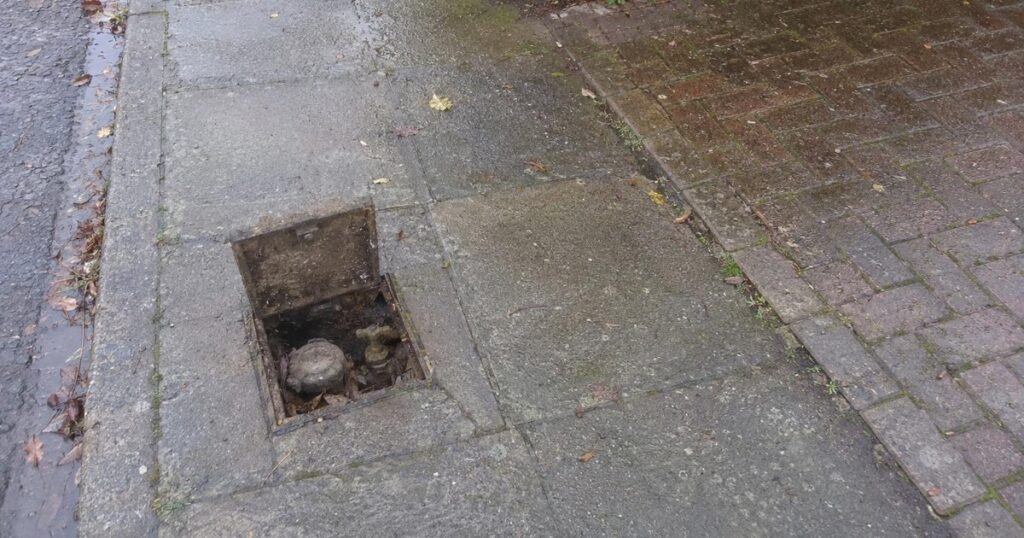
Three pipes bring water to a house, and the responsibility changes along the way. The boundary box, a small cover in the pavement or at the edge of the property holding the outside stop tap and often the meter, normally marks where the water company’s pipe ends and yours begins.
Who is responsible for each pipe
| Pipe | Where it runs | Who is responsible |
|---|---|---|
| Water main | Often under the road | The water company |
| Communication pipe | From the main to the boundary box | The water company |
| Supply pipe | From the boundary box to the first stop tap inside the house | The property owner |
| Shared supply pipe | One pipe serving more than one property | All the owners it serves, jointly |
The supply pipe is the owner’s even where it runs under the pavement or someone else’s land. Our guide to who is responsible for a water leak covers the boundary rules in more detail, and homes on a shared water supply have their own arrangements.
The two checks that show whose side it’s on
The first check is the kitchen cold tap, usually the first tap off the supply pipe, so it shows what is arriving from outside. Affinity Water’s test is to turn off every other tap and appliance, then time how long the kitchen tap takes to fill a 4.5 litre bucket. Affinity says it should take 30 seconds, and that the test only works for homes with their own supply pipe. The Consumer Council for Water suggests two everyday checks as well: a standard bath should fill in about five minutes, and a toilet cistern should refill in about 1 minute 40 seconds.
The second check is the flow at the boundary box. This is not a DIY job, because the stop tap there is usually the water company’s. The water company can measure pressure and flow at the boundary box, and that reading shows which side of the boundary the problem is on. McFadden’s team takes the same readings at the boundary box and at the kitchen tap when it is called out to a low pressure problem.
What the two checks tell you
| Kitchen cold tap | Boundary box | What it points to | Whose side |
|---|---|---|---|
| Poor | Good | A fault on the supply pipe between the boundary box and the house | Yours |
| Poor | Poor | A problem at or before the boundary: the main, the communication pipe or the local network | Usually the water company's |
| Good | Not needed | The plumbing inside the house, if other taps or the shower are weak | Yours (a plumber's job) |
What the water company has to provide, and what “1 bar” really means
The minimum set in the service standards is lower than many people expect. Water companies in England and Wales must keep a pressure of at least 7 metres static head in the communication pipe, which is about 0.7 bar. That is measured at the water company’s pipe, not at your taps. The Consumer Council for Water is clear that the company has no obligation to meet pressure requirements inside your private supply pipe, or inside the house.
When the pressure does fall below that minimum, there is compensation. In England, if the pressure in the communication pipe falls below 7 metres for an hour or more, and does so again within 28 days, the water company must pay £50, up to five payments a year. It doesn’t apply while the company is carrying out necessary repairs or maintenance, or during a drought. Companies normally pay automatically, but if they didn’t know you were affected, you need to claim within three months.
When the problem is your supply pipe
When the boundary box is fine and the house isn’t, McFadden looks at two things first: a leak on the supply pipe, and the pipe itself.
A leak on the supply pipe takes water before it reaches the taps, and can run underground for a long time without showing. If you have a meter, turn everything off and watch it: if the numbers keep moving, water is going somewhere.
An old lead or galvanised steel supply pipe is the other common cause. Old lead pipes are narrow: on Thames’s lead scheme, for example, old 12 to 15 mm lead pipe is replaced with the standard 25 mm, and galvanised steel can corrode on the inside. The pressure at the boundary can be perfectly acceptable while the flow reaching the kitchen tap is poor. As Affinity Water puts it, the flow of your water depends on your private supply pipe. Lead pipes should be replaced in any case. In the Thames, Affinity and SES areas, the water company replaces its own lead pipe once you’ve replaced yours, and our guide to lead water pipes explains how each scheme works.
A supply pipe can also be asked to do more than it was laid for. A pipe sized for one home struggles once it feeds two, after a conversion into flats or an annexe, for example. Ofwat’s reference level doubles the flow to 18 litres a minute for two properties on one pipe, which shows how much more a shared pipe has to carry.
What fixing it involves
A leak can sometimes be repaired, but where the pipe is old lead or galvanised steel, the fix is a new supply pipe from the boundary box to the house. That is groundwork rather than plumbing: the route runs under the front garden, the drive or the path, so the new pipe goes in by trench or by mole. Whether a mole can be used usually comes down to the ground conditions and the other services already buried along the route. The old pipe is replaced with a new one, usually MDPE plastic, connected at both ends, and the ground is made good.
If the connection itself needs to be bigger, that part belongs to the water company, so it starts with an application to them. McFadden can help with the application and do the digging from there, and our new water connection cost guide explains how the water company’s charges work.
A booster pump is sometimes suggested instead. Any pump drawing more than 12 litres a minute from the supply pipe needs the water company’s consent first, under regulation 5 of the Water Supply (Water Fittings) Regulations 1999. It is a consent rule, not a ban.
Low pressure in the whole house comes down to the same two checks: the kitchen tap and the boundary box. If the boundary box is fine and the house isn’t, the answer is usually on the supply pipe, and often a new supply pipe is what puts it right.
Questions on this topic
If your neighbours have it too, a sudden drop is usually a problem on the water company’s network, such as a burst main or repair work nearby. Check your water company’s live incident page first. If the network is clear, check that the inside stop tap is fully open, as it is often left half closed after other work.
In England and Wales, water companies must keep at least 7 metres static head, about 0.7 bar, in the communication pipe that serves your property. That is measured at the water company’s pipe, not at your taps. The 1 bar figure you may have heard is a service level some water companies say they aim for. The minimum the compensation scheme guarantees is 0.7 bar.
Only up to the boundary. The water company is responsible for the main and the communication pipe up to the boundary box. The supply pipe from the boundary box into the house, and the plumbing inside, belong to the property owner, and the water company has no pressure obligation inside them.
Yes, in some cases. In England, if the pressure in the communication pipe falls below 7 metres for an hour or more, and again within 28 days, the water company must pay £50, up to five payments a year. It doesn’t apply while the company is carrying out necessary repairs or maintenance, or during a drought. In Wales the payment is £25, once a year. Payments are usually automatic, but if the company didn’t know you were affected, claim within three months.
Neighbours on separate supplies, at a similar height and distance from the main, should have similar pressure. The flow, though, depends on each property’s own supply pipe. If yours is noticeably weaker, the likely cause is on your side: an old lead or galvanised supply pipe, a leak on it, or a pipe shared with another home.
It shouldn’t. Ofwat’s guidance is that you should not notice any difference in your water pressure after a water meter is fitted. If the pressure dropped straight after a meter went in, report it to your water company so it can check the meter and the boundary box.
Check Thames Water’s live incident list and postcode map first, in case there is a known problem in your area. If not, check the inside stop tap and ask your neighbours. If they are fine and you aren’t, time the kitchen cold tap and ask Thames to measure the pressure and flow at the boundary box. A good reading there points to your own supply pipe.